Class 9 · Mathematics · New NCERT
NCERT Solutions for Class 9 Mathematics Chapter 1: Orienting Yourself: The Use of Coordinates
Chapter 1 introduces the Cartesian plane: a pair of perpendicular number lines (the x-axis and y-axis) that give every point in a plane a unique address as an ordered pair of coordinates. Using a floor plan of a room, a house and a city block as running examples, the chapter develops the distance formula and the midpoint formula, and uses them to check whether points are collinear, to identify shapes such as squares and trapeziums from their vertices, and to work out spacing, widths and areas from coordinates alone.
Chapter overview
- The Cartesian plane, axes, origin and quadrants
- Plotting points from an ordered pair of coordinates
- The distance formula
- The midpoint formula
- Testing whether three points are collinear
- Identifying shapes (squares, trapeziums, triangles) from vertex coordinates
Orienting Yourself: The Use of Coordinates
This chapter builds on the idea of a number line by adding a second, perpendicular number line to it, giving every point in a plane its own unique address — an ordered pair of numbers called coordinates. The chapter uses a floor plan of a room (and later a whole house and a city) to show how coordinates describe real positions, distances and shapes, and it develops the distance formula and the midpoint formula as the main tools for working with them.
Cartesian plane
A flat surface on which two number lines — a horizontal x-axis and a vertical y-axis — cross at right angles at a point called the origin, written O(0, 0). Every point on the plane can then be located by an ordered pair (x, y): x is the distance moved along the x-axis (right is positive, left is negative) and y is the distance moved along the y-axis (up is positive, down is negative).
| Quadrant | Sign of x | Sign of y | Example point |
|---|---|---|---|
| I | + | + | (3, 2) |
| II | − | + | (−3, 2) |
| III | − | − | (−3, −2) |
| IV | + | − | (3, −2) |
Distance formula
The distance between two points A(x₁, y₁) and B(x₂, y₂) in the coordinate plane is AB = √[(x₂ − x₁)² + (y₂ − y₁)²]. For two points on the same horizontal or vertical line, this reduces to the simple difference of the matching coordinates.
Midpoint formula
The midpoint M of a segment joining A(x₁, y₁) and B(x₂, y₂) is M = ((x₁ + x₂)/2, (y₁ + y₂)/2). Equivalently, M is equidistant from A and B, i.e. AM = MB.
Exercise Set 1.1
Fig. 1.3 shows Reiaan's room with its four corners marked O, A, B and C. The x-axis runs along the bottom wall and the y-axis along the left wall, with O at the origin. Every piece of furniture and every door in the room is also given coordinates on the same grid, one unit representing one foot.
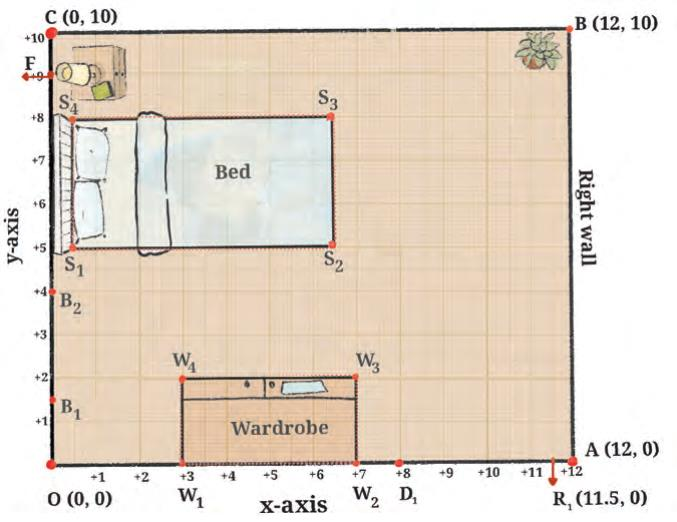
Image unavailable. Open original
Fig. 1.3: Reiaan's room plotted on the coordinate plane, corners O(0,0), A(12,0), B(12,10), C(0,10), with the bed, wardrobe and door marked
(i) If D₁R₁ represents the door to Reiaan's room, how far is the door from the left wall (the y-axis) of the room? How far is it from the x-axis?
Answer
The door D₁R₁ lies flat along the bottom wall, i.e. along the x-axis, so every point on it has a y-coordinate of 0 — its distance from the x-axis is 0 units.
From the figure, D₁ = (8, 0). Its distance from the left wall (the y-axis) is just its x-coordinate:
(ii) What are the coordinates of D₁?
Answer
Reading directly off the grid, D₁ = (8, 0).
(iii) If R₁ is the point (11.5, 0), how wide is the door? Do you think this is a comfortable width for the room door? If a person in a wheelchair wants to enter the room, will they be able to do so easily?
Answer
Both D₁ and R₁ lie on the x-axis, so the door's width is simply the difference of their x-coordinates.
Steps
- D₁ = (8, 0) and R₁ = (11.5, 0)
- Width of door = 11.5 − 8 = 3.5 units
Taking each unit as one foot, the door is 3.5 ft (about 42 inches) wide.
- A standard residential door is usually 30–36 inches wide, so this door is slightly wider than average — a comfortable width.
- A wheelchair typically needs at least 32 inches (about 2.7 ft) of clear width to pass through.
- Since 3.5 ft > 2.7 ft, the door is wide enough for a wheelchair user to enter without difficulty.
(iv) If B₁(0, 1.5) and B₂(0, 4) represent the ends of the bathroom door, is the bathroom door narrower or wider than the room door?
Answer
B₁ and B₂ both lie on the y-axis, so the bathroom door's width is the difference of their y-coordinates.
Steps
- B₁ = (0, 1.5) and B₂ = (0, 4)
- Width of bathroom door = 4 − 1.5 = 2.5 units
Since 2.5 units < 3.5 units, the bathroom door is narrower than the room door.
Exercise Set 1.2
On a graph sheet, mark the x-axis and y-axis and the origin O. Mark points from (−7, 0) to (13, 0) on the x-axis and from (0, −15) to (0, 12) on the y-axis, using the scale 1 cm = 1 unit. Fig. 1.5 extends Reiaan's room to include the bathroom next to it, and is used to answer the questions below.
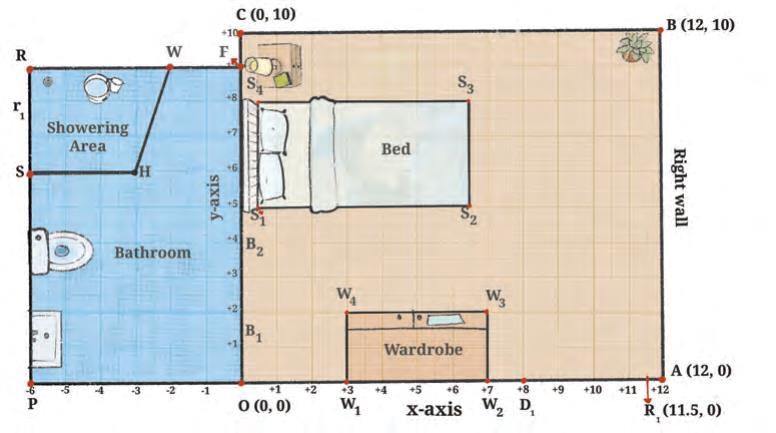
Image unavailable. Open original
Fig. 1.3 extended: Reiaan's bedroom together with the adjoining bathroom, showing the showering area, toilet and washbasin corners P, O, F, R
Q1. Place Reiaan's rectangular study table with three of its feet at the points (8, 9), (11, 9) and (11, 7).
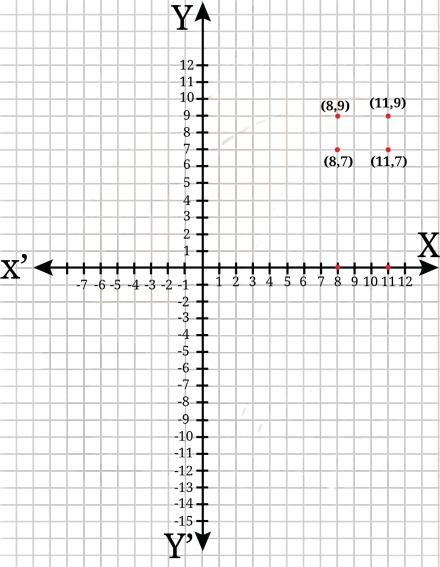
Image unavailable. Open original
Grid showing three feet of the study table plotted at (8,9), (11,9) and (11,7)
Q1(i). Where will the fourth foot of the table be?
Answer
The three given points are three corners of a rectangle: A(8, 9), B(11, 9) and C(11, 7). AB is horizontal (same y-coordinate) and BC is vertical (same x-coordinate), so the fourth corner must share its x-coordinate with A and its y-coordinate with C.
Q1(ii). Is this a good spot for the table?
Answer
Yes — the table sits neatly inside the room, near the wall, without blocking any door or walkway, which makes it a practical and unobtrusive spot for studying.
Q1(iii). What is the width of the table? The length? Can you make out the height of the table?
Answer
Steps
- Width = distance between (8, 9) and (11, 9) = 11 − 8 = 3 units
- Length = distance between (11, 9) and (11, 7) = 9 − 7 = 2 units
Q2. If the bathroom door has a hinge at B₁ and opens into the bedroom, will it hit the wardrobe? Are there any changes you would suggest if the door is made wider?
Answer
From the figure, B₁ = (0, 1.5) and B₂ = (0, 4), so the bathroom door is 4 − 1.5 = 2.5 units wide.
Hinged at B₁ and swinging into the bedroom, the door sweeps out a quarter-circle arc of radius 2.5 units centred on B₁(0, 1.5). The wardrobe's nearest edge, W₁(3, 0)–W₄(3, 2), starts at x = 3, which is farther from the y-axis than the door's 2.5-unit swing radius.
- If the door were made noticeably wider, its swing could reach or hit the wardrobe.
- A wider door could instead be hinged to open inward into the bathroom.
- Alternatively, the wardrobe could be shifted a little further to the right, or the door's width could be kept limited to what the room comfortably allows.
Q3. Look at Reiaan's bathroom.
Q3(i). What are the coordinates of the four corners O, F, R and P of the bathroom?
Answer
Reading these directly from Fig. 1.5:
| Corner | Coordinates |
|---|---|
| O | (0, 0) |
| F | (0, 9) |
| R | (−6, 9) |
| P | (−6, 0) |
Q3(ii). What is the shape of the showering area SHWR in Reiaan's bathroom? Write the coordinates of its four corners.
Answer
| Corner | Coordinates |
|---|---|
| S | (−6, 5) |
| H | (−3, 5) |
| W | (−2, 9) |
| R | (−6, 9) |
SR and HW are the two sides parallel to the y-axis, while SH is horizontal; WR is slanted, so only one pair of opposite sides (SH and, more precisely, the pair through the y-axis-parallel sides) is parallel. With exactly one pair of parallel sides, SHWR is a trapezium.
Q3(iii). Mark off a 3 ft × 2 ft space for the washbasin and a 2 ft × 3 ft space for the toilet. Write the coordinates of the corners of these spaces.
Answer
Taking the washbasin in the bottom-left corner of the bathroom and the toilet directly above it:
| Fixture | Corners |
|---|---|
| Washbasin (3 ft × 2 ft) | (−6, 0), (−3, 0), (−3, 2), (−6, 2) |
| Toilet (2 ft × 3 ft) | (−6, 2), (−4, 2), (−4, 5), (−6, 5) |
Q4. Other rooms in the house:
Q4(i). Reiaan's room door leads from the dining room, which has length 18 ft and width 15 ft. The length of the dining room extends from point P to point A. Sketch the dining room and mark the coordinates of its corners.
Answer
From the figure, P = (−6, 0) and A = (12, 0), so PA = 12 − (−6) = 18 ft, matching the given length.
Taking the dining room to be 15 ft wide and to lie below PA (extending 15 units downward), its four corners are:
| Corner | Coordinates |
|---|---|
| P | (−6, 0) |
| A | (12, 0) |
| Q | (12, −15) |
| S | (−6, −15) |
Q4(ii). Place a rectangular 5 ft × 3 ft dining table precisely in the centre of the dining room. Write down the coordinates of the feet of the table.
Answer
The dining room spans x from −6 to 12 and y from 0 to −15, so its centre is:
Steps
- x-coordinate of centre = (−6 + 12) / 2 = 3
- y-coordinate of centre = (0 + (−15)) / 2 = −7.5
A 5 ft × 3 ft table centred there extends 2.5 units either side in x and 1.5 units either side in y, giving corners:
End-of-Chapter Exercises
Q1. What are the x-coordinate and y-coordinate of the point of intersection of the two axes?
Answer
The x-axis and y-axis cross exactly at the origin, where both coordinates are zero.
Q2. Point W has x-coordinate equal to −5. Can you predict the coordinates of point H, which is on the line through W parallel to the y-axis? Which quadrants can H lie in?
Answer
Every point on a line parallel to the y-axis shares the same x-coordinate, so H must have the form H = (−5, y) for some real number y.
- If y > 0, H lies in Quadrant II.
- If y < 0, H lies in Quadrant III.
- If y = 0, H lies on the x-axis itself.
So H can lie in Quadrant II, Quadrant III, or on the x-axis — but never in Quadrant I or IV, since its x-coordinate is fixed as negative.
Q3. Consider the points R(3, 0), A(0, −2), M(−5, −2) and P(−5, 2). If they are joined in the same order, predict:
Q3(i). Two sides of RAMP that are perpendicular to each other.
Answer
AM joins A(0, −2) to M(−5, −2): both points share y = −2, so AM is horizontal. MP joins M(−5, −2) to P(−5, 2): both points share x = −5, so MP is vertical. A horizontal segment and a vertical segment are always perpendicular.
Q3(ii). One side of RAMP that is parallel to one of the axes.
Answer
AM is parallel to the x-axis (constant y = −2), and MP is parallel to the y-axis (constant x = −5) — either qualifies as an answer.
Q3(iii). Two points that are mirror images of each other in one axis. Which axis will this be? Now plot the points and verify your predictions.
Answer
M(−5, −2) and P(−5, 2) share the same x-coordinate, and their y-coordinates are equal in size but opposite in sign. That is exactly the pattern of a reflection in the x-axis, so M and P are mirror images of each other in the x-axis.
Q4. Plot point Z(5, −6) on the Cartesian plane. Construct a right-angled triangle IZN and find the lengths of the three sides.
Answer
Taking I = (5, 0) on the x-axis and N = (0, −6) on the y-axis, IZ is vertical and ZN is horizontal, so triangle IZN is right-angled at Z.
Steps
- IZ = distance between (5, 0) and (5, −6) = 0 − (−6) = 6 units
- ZN = distance between (5, −6) and (0, −6) = 5 − 0 = 5 units
- IN = √[(5−0)² + (0−(−6))²] = √(25 + 36) = √61 units
So IZ = 6 units, ZN = 5 units and IN = √61 units.
Q5. What would a system of coordinates be like if we did not have negative numbers? Would this system allow us to locate all the points on a 2-D plane?
Answer
Without negative numbers, every coordinate would have to be zero or positive, so points could only be marked to the right of the origin on the x-axis and above the origin on the y-axis.
That restricts every locatable point to Quadrant I, the positive x-axis, the positive y-axis, and the origin itself.
- Points in Quadrant II, III and IV could not be located.
- Points on the negative parts of either axis could not be located.
So such a system would not be able to locate every point on the plane — negative numbers are essential for that.
Q6. Are the points M(−3, −4), A(0, 0) and G(6, 8) on the same straight line? Suggest a method to check this without plotting and joining the points.
Answer
Three points are collinear exactly when the distance between the two outer points equals the sum of the distances to the point in between.
Steps
- MA = √[(0-(-3))² + (0-(-4))²] = √(9+16) = √25 = 5
- AG = √[(6-0)² + (8-0)²] = √(36+64) = √100 = 10
- MG = √[(6-(-3))² + (8-(-4))²] = √(81+144) = √225 = 15
Since MA + AG = MG, the points M, A and G do lie on the same straight line.
Q7. Use your method from Question 6 to check if the points R(−5, −1), B(−2, −5) and C(4, −12) are on the same straight line. Now plot both sets of points and check your answers.
Answer
Steps
- RB = √[(-2+5)² + (-5+1)²] = √(9+16) = √25 = 5
- BC = √[(4+2)² + (-12+5)²] = √(36+49) = √85
- RC = √[(4+5)² + (-12+1)²] = √(81+121) = √202
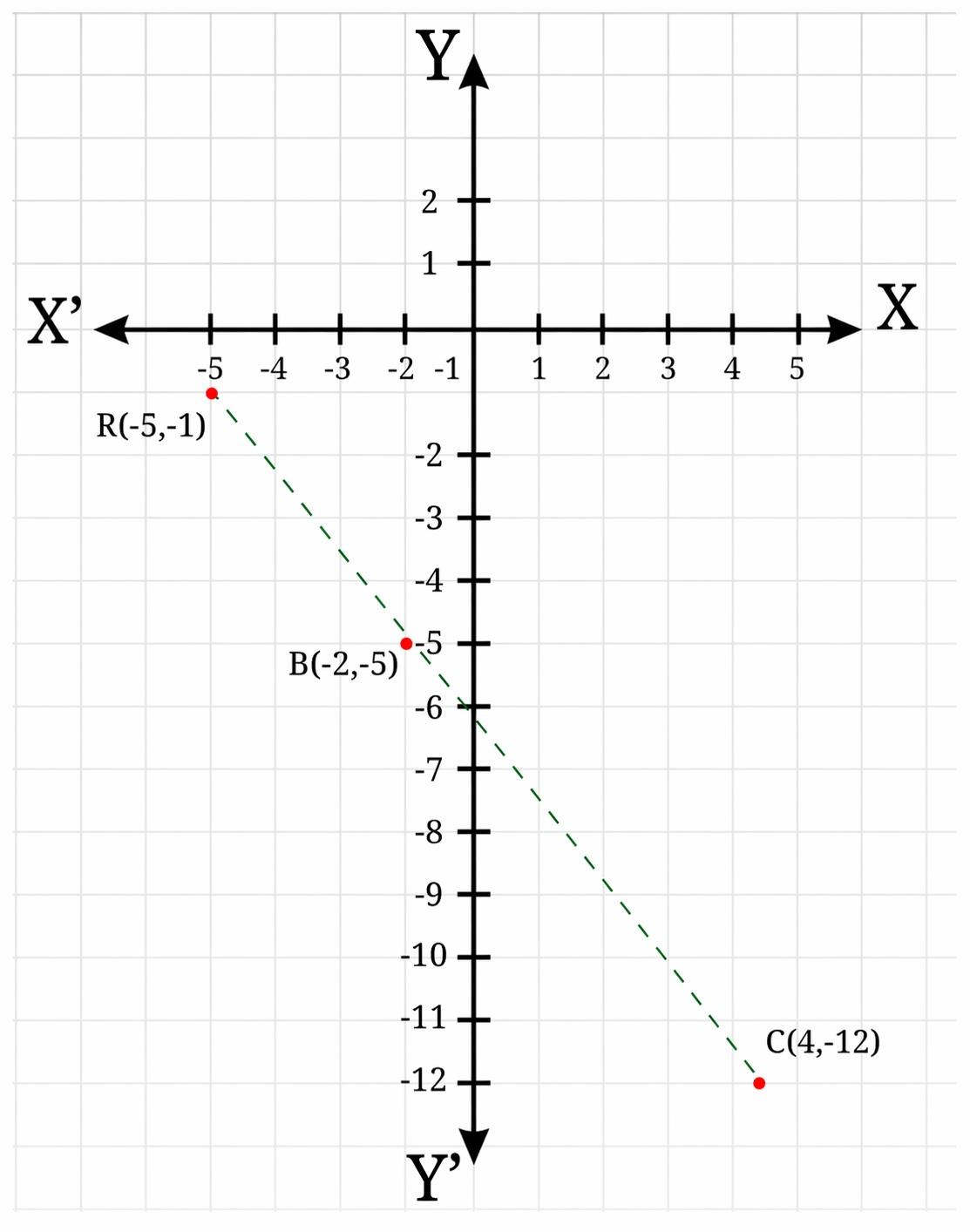
Image unavailable. Open original
R(-5,-1), B(-2,-5) and C(4,-12) plotted and joined by a dashed line, showing they lie on one straight line
Since RB + BC is not equal to RC, the points R, B and C do not lie on the same straight line — the plot above confirms the visible bend at B.
Q8. Using the origin as one vertex, plot the vertices of:
Q8(i). A right-angled isosceles triangle.
Answer
One valid choice is O(0, 0), A(4, 0) and B(0, 4).
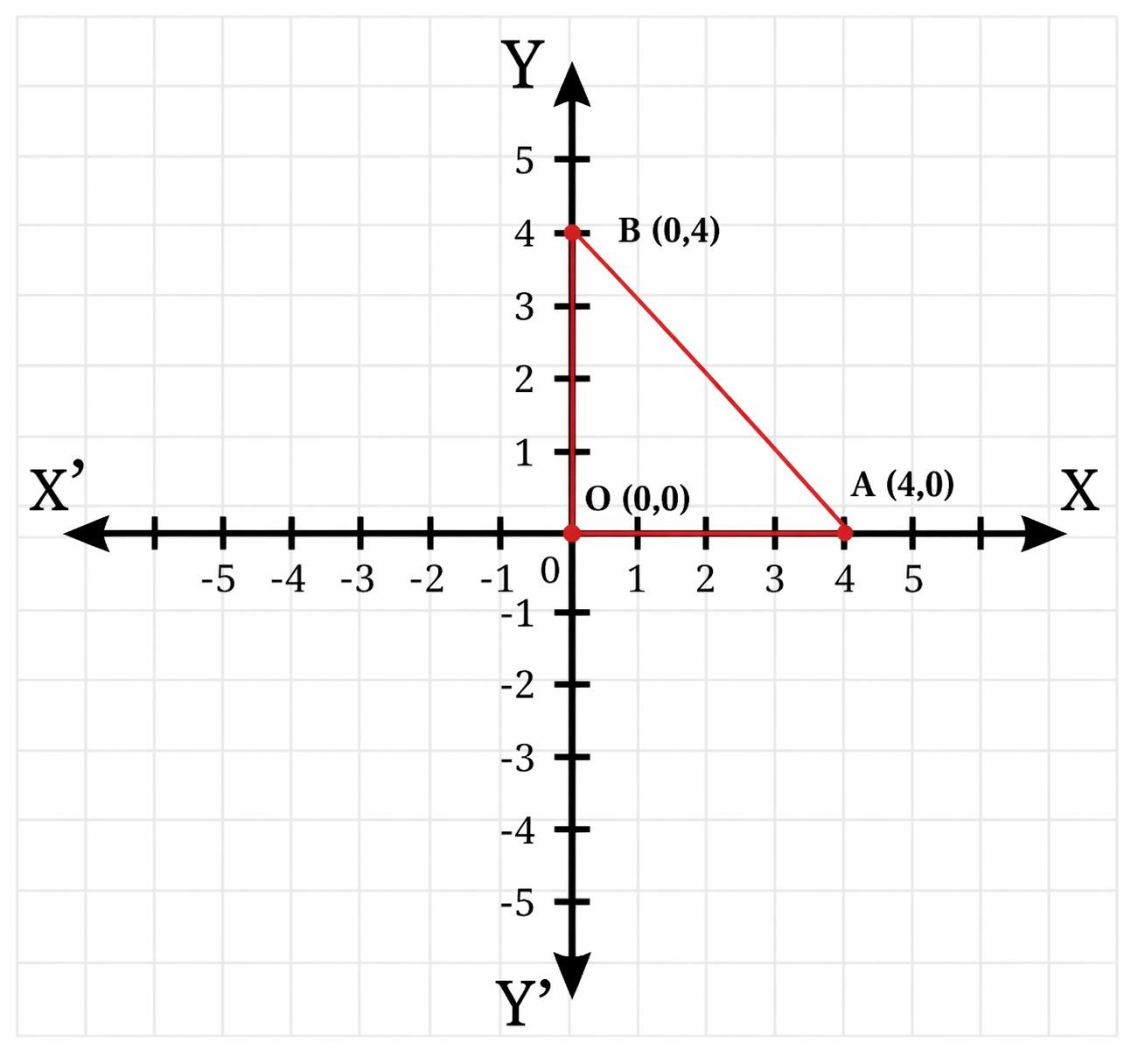
Image unavailable. Open original
Right-angled isosceles triangle OAB with O(0,0), A(4,0) and B(0,4)
OA = 4 units and OB = 4 units, with OA perpendicular to OB, so triangle OAB is right-angled at O with two equal legs — a right-angled isosceles triangle.
Q8(ii). An isosceles triangle with one vertex in Quadrant III and the other in Quadrant IV.
Answer
One valid choice is O(0, 0), P(−3, −4) and Q(3, −4), with P in Quadrant III and Q in Quadrant IV.
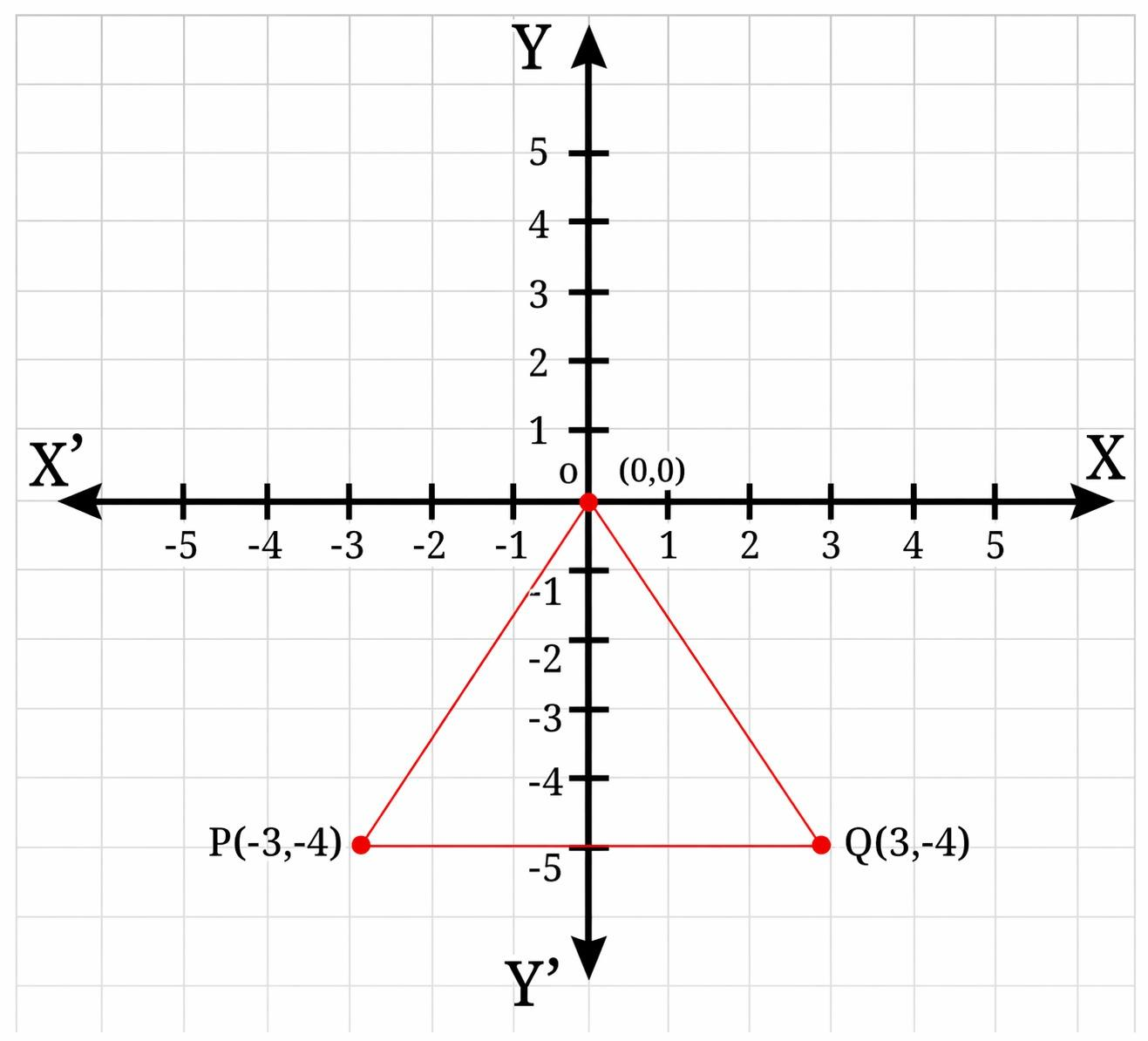
Image unavailable. Open original
Isosceles triangle OPQ with O(0,0), P(-3,-4) in quadrant III and Q(3,-4) in quadrant IV
OP = OQ = √(9+16) = 5 units, so triangle OPQ is isosceles.
Q9. The table below gives the coordinates of points S, M and T. In each case, state whether M is the midpoint of segment ST, and justify your answer. When M is the midpoint of ST, can you find any connection between the coordinates of M, S and T?
| S | M | T |
|---|---|---|
| (−3, 0) | (0, 0) | (3, 0) |
| (2, 3) | (3, 4) | (4, 5) |
| (0, 0) | (0, 5) | (0, −10) |
| (−8, 7) | (0, −2) | (6, −3) |
Answer
M is the midpoint of ST exactly when SM = MT. Checking each row with the distance formula:

Image unavailable. Open original
S(-3,0), M(0,0) and T(3,0) plotted on the x-axis
Steps
- Row 1: S(−3,0), M(0,0), T(3,0) → SM = √[9+0] = 3, MT = √[9+0] = 3
- SM = MT, so M IS the midpoint.

Image unavailable. Open original
S(2,3), M(3,4) and T(4,5) plotted on the coordinate plane
Steps
- Row 2: S(2,3), M(3,4), T(4,5) → SM = √[1+1] = √2, MT = √[1+1] = √2
- SM = MT, so M IS the midpoint.

Image unavailable. Open original
M(0,5) and T(5,0) with T'(0,-10) plotted on the y-axis and x-axis
Steps
- Row 3: S(0,0), M(0,5), T(0,−10) → SM = √[0+25] = 5, MT = √[0+225] = 15
- SM ≠ MT (5 ≠ 15), so M is NOT the midpoint.

Image unavailable. Open original
S(-8,7), M(0,-2) and T(6,-3) plotted on the coordinate plane
Steps
- Row 4: S(−8,7), M(0,−2), T(6,−3) → SM = √[64+81] = √145, MT = √[36+1] = √37
- SM ≠ MT (√145 ≠ √37), so M is NOT the midpoint.
In every row where M really is the midpoint, M's x-coordinate is exactly halfway between S and T's x-coordinates, and likewise for the y-coordinates — which is the midpoint formula.
Q10. Use the connection you found to find the coordinates of B, given that M(−7, 1) is the midpoint of A(3, −4) and B(x, y).
Answer
By the midpoint formula, M's coordinates are the average of A's and B's:
Steps
- (3 + x)/2 = −7 ⇒ 3 + x = −14 ⇒ x = −17
- (−4 + y)/2 = 1 ⇒ −4 + y = 2 ⇒ y = 6
Q11. Let P, Q be the points of trisection of AB, with P closer to A and Q closer to B. Using your knowledge of the midpoint of a segment, how would you find the coordinates of P and Q? Do this for A(4, 7) and B(16, −2).
Answer
Trisection points split AB into three equal parts, so P is the midpoint of A and Q, and Q is in turn the midpoint of P and B. That gives two midpoint equations in the two unknown points, which can be solved together.
Steps
- P is midpoint of A, Q: x₁ = (4 + x₂)/2 and y₁ = (7 + y₂)/2
- Q is midpoint of P, B: x₂ = (x₁ + 16)/2 and y₂ = (y₁ − 2)/2
- Substituting one into the other: x₂ = ((4+x₂)/2 + 16)/2 = (x₂+36)/4 → 3x₂ = 36 → x₂ = 12, then x₁ = (4+12)/2 = 8
- Similarly: y₂ = ((7+y₂)/2 − 2)/2 = (y₂+3)/4 → 3y₂ = 3 → y₂ = 1, then y₁ = (7+1)/2 = 4
Q12(i). Given the points A(1, −8), B(−4, 7) and C(−7, −4), show that they lie on a circle K whose centre is the origin O(0, 0). What is the radius of circle K?
Answer
Points lie on a common circle centred at O exactly when they are all the same distance from O.
Steps
- OA = √(1² + (−8)²) = √(1+64) = √65
- OB = √((−4)² + 7²) = √(16+49) = √65
- OC = √((−7)² + (−4)²) = √(49+16) = √65
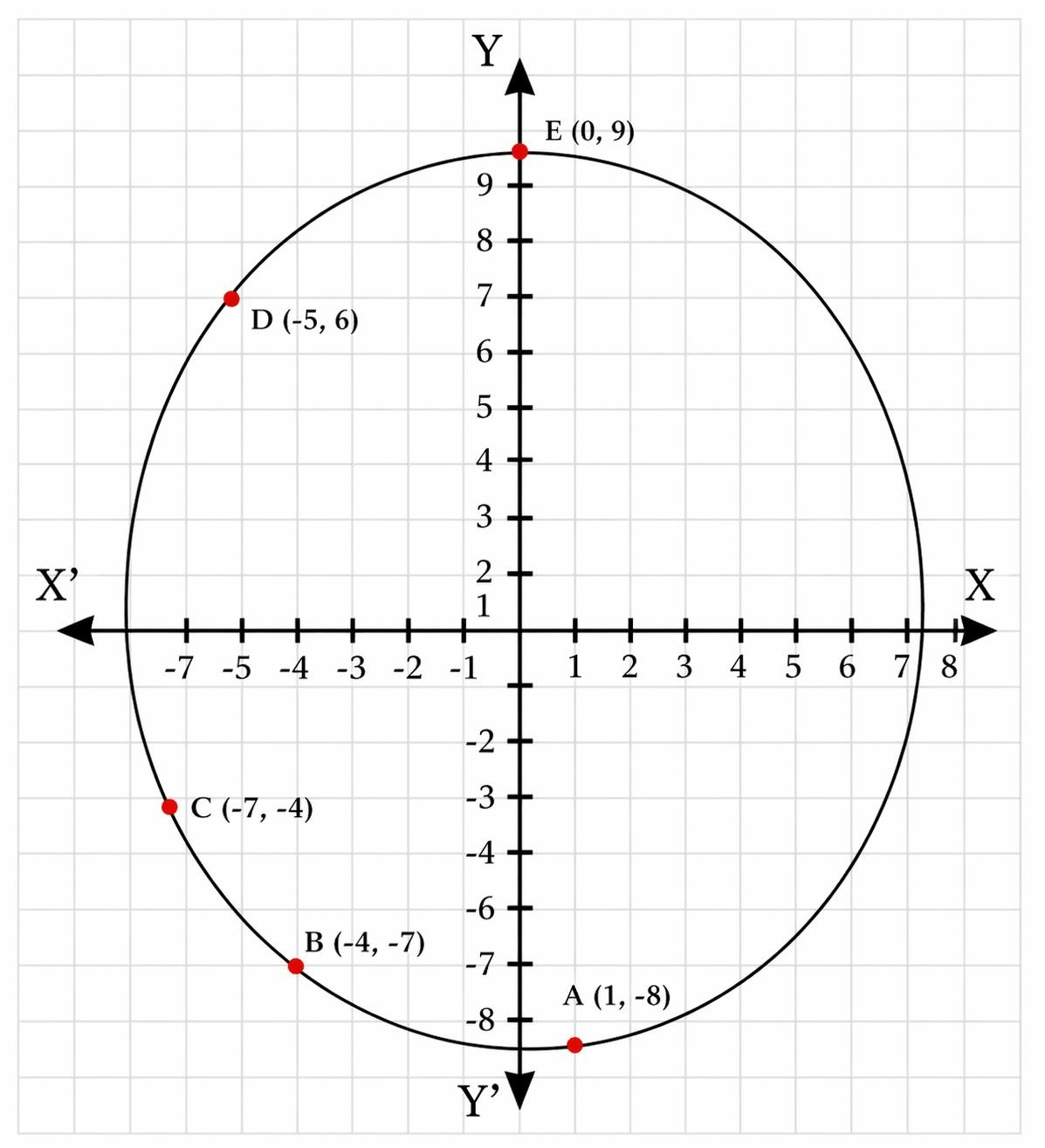
Image unavailable. Open original
Circle K centred at the origin passing through A(1,-8), B(-4,-7), C(-7,-4), D(-5,6) and E(0,9)
Since OA = OB = OC = √65, points A, B and C all lie on circle K, centred at the origin with radius √65.
Q12(ii). Given the points D(−5, 6) and E(0, 9), check whether D and E lie within the circle, on the circle, or outside circle K.
Answer
Steps
- OD = √((−5)² + 6²) = √(25+36) = √61 ≈ 7.81
- OE = √(0² + 9²) = 9
Comparing these with the radius √65 ≈ 8.06:
- √61 < √65, so D lies inside the circle.
- 9 > √65, so E lies outside the circle.
Q13. The midpoints of the sides of triangle ABC are the points D, E and F. Given that the coordinates of D, E and F are (5, 1), (6, 5) and (0, 3) respectively, find the coordinates of A, B and C.
Answer
Let A = (x₁, y₁), B = (x₂, y₂) and C = (x₃, y₃). Since D is the midpoint of BC, E of CA, and F of AB:

Image unavailable. Open original
Triangle ABC with D, E and F marking the midpoints of sides BC, CA and AB, with D(5,1), E(6,5), F(0,3)
Steps
- x₂ + x₃ = 10 and y₂ + y₃ = 2 (from D)
- x₃ + x₁ = 12 and y₃ + y₁ = 10 (from E)
- x₁ + x₂ = 0 and y₁ + y₂ = 6 (from F)
- Adding the three x-equations and halving gives x₁+x₂+x₃ = 11; subtracting each pair: x₁ = 1, x₂ = −1, x₃ = 11
- The same approach on the y-equations gives y₁ = 7, y₂ = −1, y₃ = 3
Q14. A city has two main roads crossing at the centre, running North–South and East–West. All other streets run parallel to these and are 200 m apart, with 10 streets in each direction.
Q14(i). Using 1 cm = 200 m, draw a model of the city, representing the roads and streets by single lines.
Answer
With 10 streets 200 m (1 cm) apart in each direction, the model is a square grid of 10 vertical (N–S) lines and 10 horizontal (E–W) lines, crossing the two main roads at the centre.
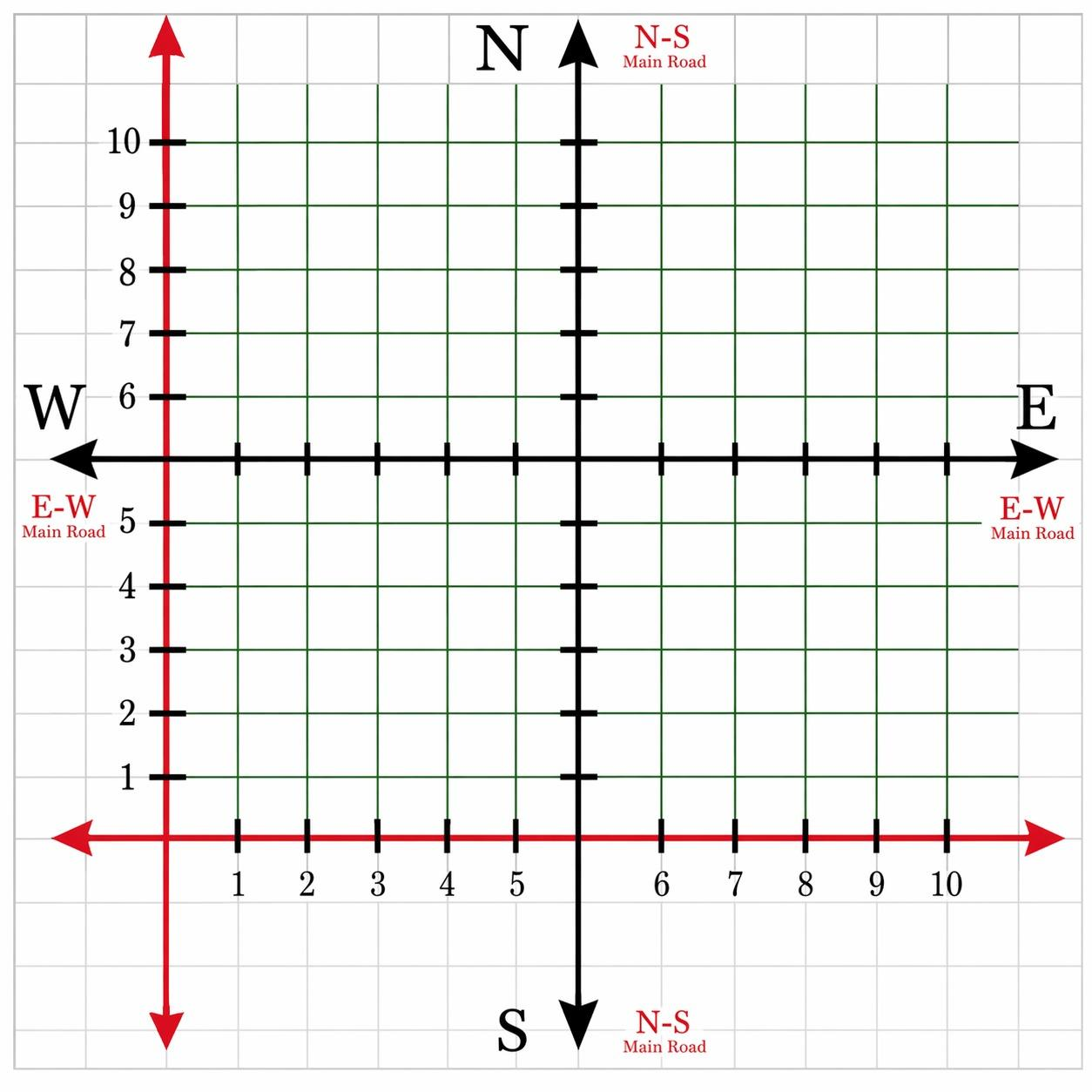
Image unavailable. Open original
Blank model of the city grid: 10 north-south streets and 10 east-west streets, 200 m apart, crossing at the centre
Q14(ii). Each street intersection is named (N–S street number, E–W street number) — for example, the crossing of the 2nd N–S street and the 5th E–W street is called (2, 5). Using this convention, find how many street intersections can be referred to as (a) (4, 3) and (b) (3, 4).
Answer
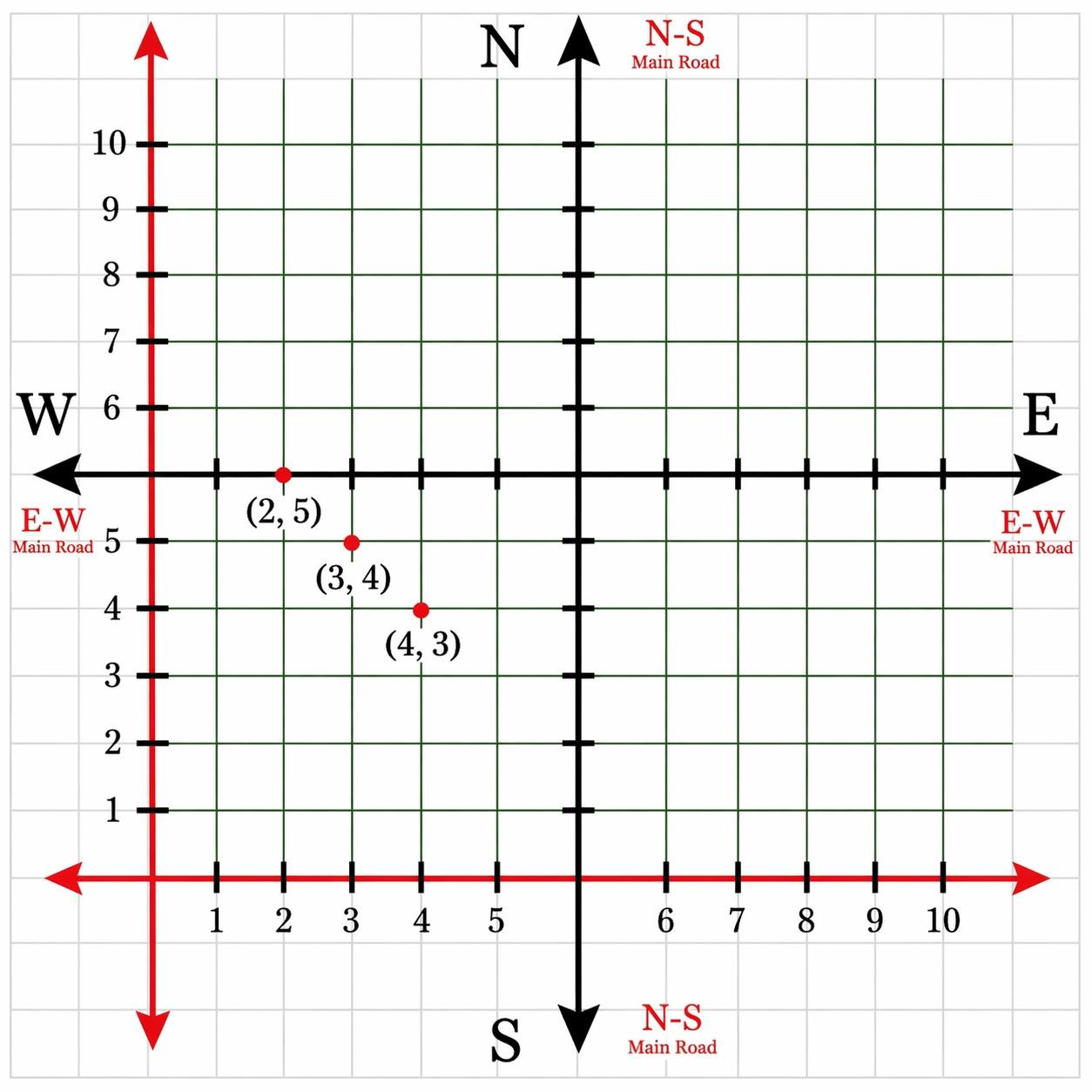
Image unavailable. Open original
City grid with the intersections (2,5), (3,4) and (4,3) marked
(4, 3) means the crossing of the 4th N–S street with the 3rd E–W street, while (3, 4) means the crossing of the 3rd N–S street with the 4th E–W street — these are two different streets meeting at two different points.
Any one N–S street and any one E–W street cross at exactly one point, so:
- Only one intersection can be called (4, 3).
- Only one intersection can be called (3, 4).
Q15. A computer graphics program displays images on an 800 × 600 pixel screen whose origin is at the bottom-left corner. A circular icon of radius 80 px is centred at A(100, 150); another of radius 100 px is centred at B(250, 230).
Q15(i). Does any part of either circle lie outside the screen?
Answer
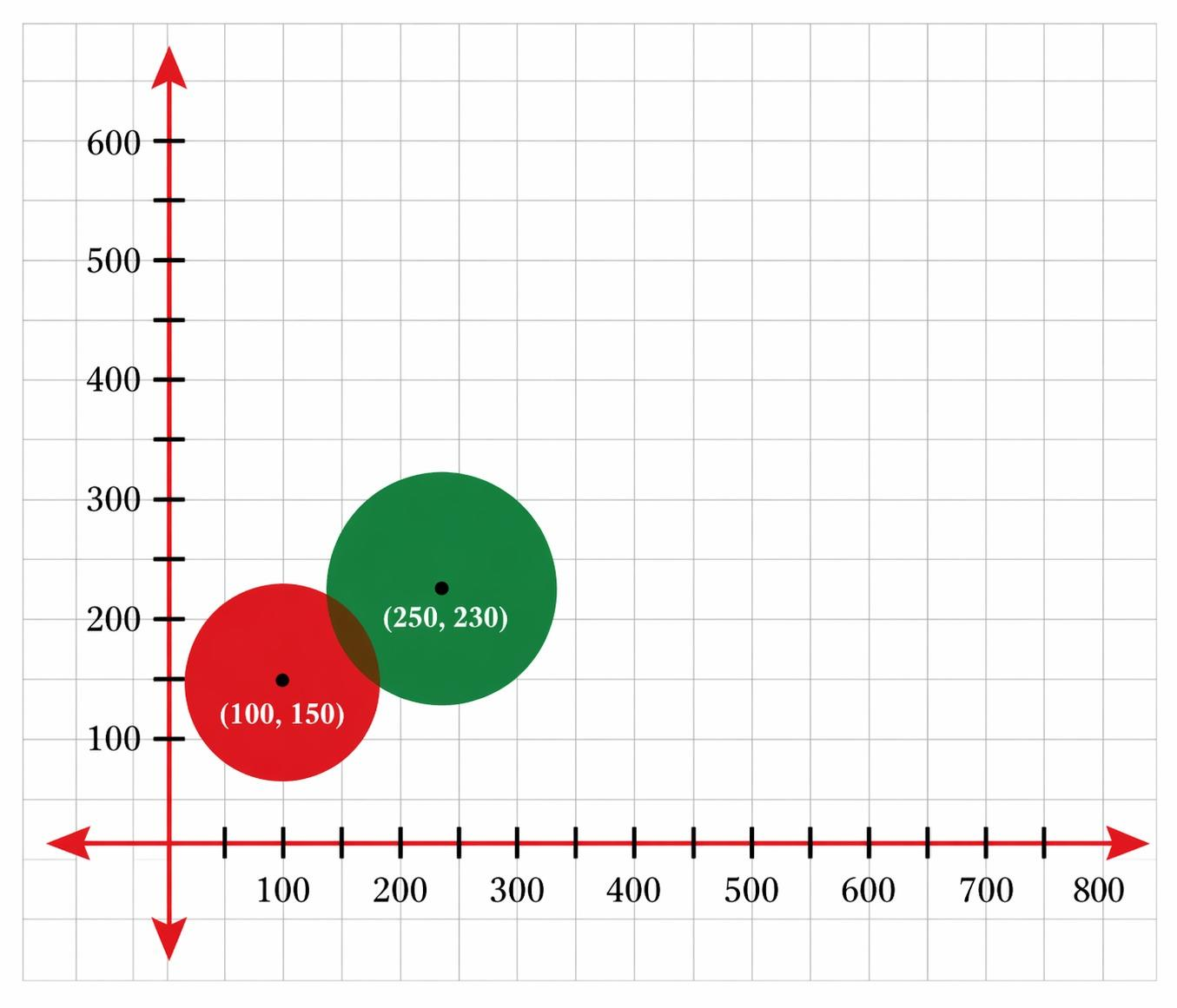
Image unavailable. Open original
800 by 600 pixel screen with a radius-80 circle centred at A(100,150) and a radius-100 circle centred at B(250,230), overlapping near the middle
Circle A spans x from 20 to 180 and y from 70 to 230 — comfortably inside the 800×600 screen. Circle B spans x from 150 to 350 and y from 130 to 330 — also fully inside. So no, neither circle extends beyond the screen.
Q15(ii). Do the two circles intersect each other?
Answer
Steps
- Distance AB = √[(250−100)² + (230−150)²] = √(150²+80²) = √(22500+6400) = √28900 = 170
- Sum of radii = 80 + 100 = 180; difference of radii = 100 − 80 = 20
Since 20 < 170 < 180, the distance between the centres is less than the sum of the radii but more than their difference, so the two circles overlap — they do intersect, as shown in the figure above.
Q16. Plot the points A(2, 1), B(−1, 2), C(−2, −1) and D(1, −2) in the coordinate plane. Is ABCD a square? Can you explain why? What is the area of this square?
Answer
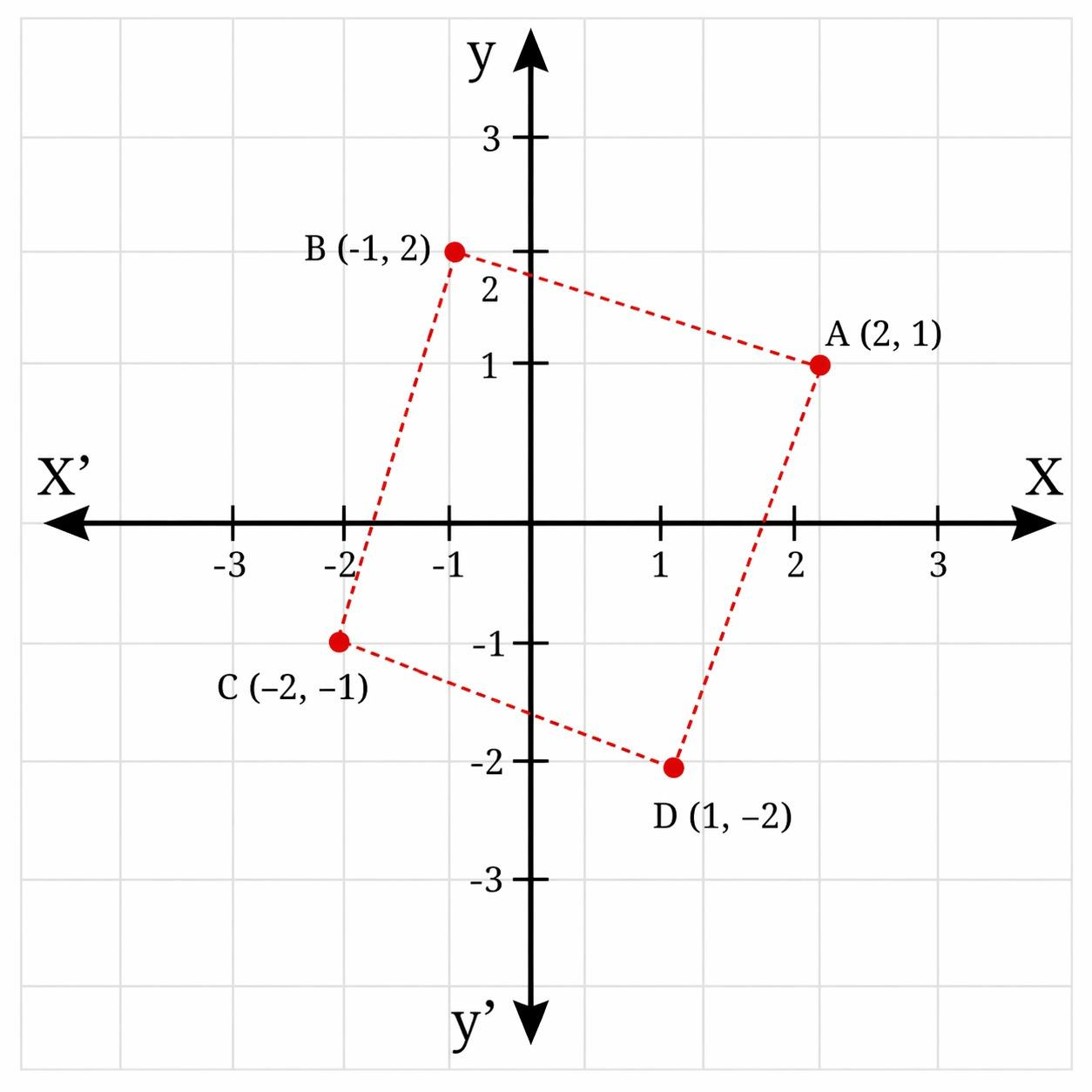
Image unavailable. Open original
Square ABCD plotted with A(2,1), B(-1,2), C(-2,-1) and D(1,-2) joined by dashed lines
Steps
- AB = √[(−1−2)²+(2−1)²] = √(9+1) = √10
- BC = √[(−2+1)²+(−1−2)²] = √(1+9) = √10
- CD = √[(1+2)²+(−2+1)²] = √(9+1) = √10
- DA = √[(2−1)²+(1+2)²] = √(1+9) = √10
- Diagonals: AC = √[(−2−2)²+(−1−1)²] = √20, BD = √[(1+1)²+(−2−2)²] = √20
All four sides equal √10 and both diagonals equal √20, so ABCD is indeed a square.